Wool Rug Cleaning and Repair
California Rug Cleaning provides wool rug cleaning and repair by hand at our Canoga Park facility. We clean every grade of wool, from New Zealand and Himalayan wool to Persian village and Indian wool. Cleaning starts at $3 per square foot, with free pickup within 20 miles.
What We Consider Before Wool Rug Cleaning
Wool is the most forgiving rug fiber to live with and one of the least forgiving to clean with the wrong product. It’s a protein, chemically close to human hair, and nearly every cleaning rule follows from that. The same “wool rug” label covers an inexpensive tufted rug and a hand-knotted heirloom, so the fiber and the construction both have to be read before any water goes on.
Wool Is Sensitive to Harsh Cleaners
Wool is a natural fiber, a lot like human hair, and it only stays healthy with gentle cleaners. Many everyday carpet cleaners are made for synthetic carpet, which can handle much harsher products than wool can.
The risk
Harsh cleaners weaken wool, make it rough and brittle, and can make the colors run. That’s how a red or blue pattern bleeds into a white border. Bleach, “oxy” sprays and enzyme stain removers are especially harmful, because they’re designed to break down the same natural material wool is made of.
How we handle it
We use only gentle, wool-safe cleaners, never harsh carpet chemicals, bleach or enzyme products. Before washing, we test every color so we know ahead of time if any dye might run.
How Wool Reacts to Water
Each wool fiber is covered in tiny overlapping scales, like shingles on a roof. When the fiber is dry and handled gently, the scales lie flat. But wool can soak up about 30% of its own weight in water, and when it’s wet, those scales soften and loosen, ready to catch on neighboring fibers.
The risk
Heat and aggressive scrubbing can cause wet wool fibers to lock together. This permanent change, called felting, can shrink the rug, mat the pile, and alter its texture. Slow drying may also cause musty odors, mildew, and brown discoloration.
How we handle it
We use cool water and gentle, controlled brushing instead of steam or hot-water extraction. Delicate, looped, or loosely spun wool is brushed by hand, then dried flat with steady airflow.
How the rug was built
Wool fibers are naturally wavy, so the pile is springy and full of tiny air pockets. Dirt sinks down into those spaces, out of sight, instead of sitting on top where you’d see it.
The risk
If a rug is washed without removing hidden dirt first, the water turns the grit into mud that sinks even deeper into the foundation, leaving the rug dull and prone to resoiling quickly.
How we handle it
Before any water touches the rug, we remove the dry soil, working from the back so the buried grit is shaken loose rather than pushed deeper. Only once the rug is free of that grit do we wash it, so the cleaning solution can rinse all the way through.
Our Wool Rug Cleaning Process
Area rugs need more than a quick pass with a carpet-cleaning wand. Surface cleaning may improve their appearance, but it can leave grit deep in the foundation . At our facility, we take your rug through a complete cleaning process that goes beyond the surface, removing hidden buildup and bringing out its natural beauty.
We check the fiber, construction, backing, fringe and existing damage, so the wash matches how the rug was built.
Every color is tested, because wool dyes vary in how well they hold.
The rug is vacuumed thoroughly to pull out the grit worked down to the foundation before any water is used.
Cool water and a pH-neutral, wool-safe solution. Hand-knotted rugs get a full wash, and hand-tufted rugs are cleaned with less water on the backing to protect the latex.
Fringe and bound edges are cleaned separately by hand.
The rug is flushed and squeegeed again and again until the water running off it is clear, not just until the rug looks clean, because detergent left behind attracts soil. The last of the surface water is squeegeed out before the rug goes to dry.
Flat, fast and controlled, with airflow to prevent browning, odor, shrinkage and distortion.
The pile is groomed back to its natural direction and the rug is checked to make sure it lies flat and square.

How Often Should You Schedule Wool Rug Cleaning?
Most wool rugs benefit from a professional wash every 12 to 24 months. Rugs in a home with pets or children, or in heavy traffic, need it sooner.
Signs yours is due
·
The pile looks flat or matted in traffic lanes
·
Colors look dull or grayish
·
Grit you can feel at the base of the pile
·
Any odor, especially after humid weather
Wool rug repair
Wool Rug Repair for Every Construction
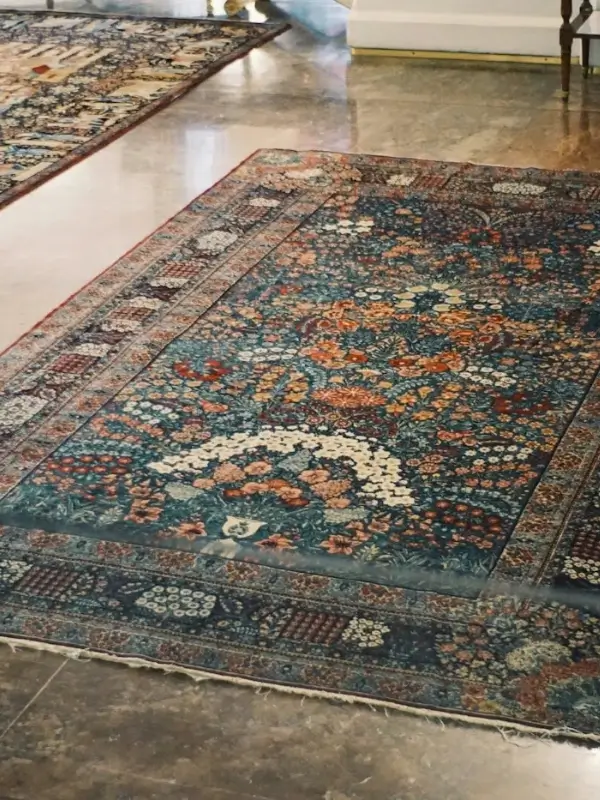
What can be repaired on a wool rug depends almost entirely on how it was built. A hand-knotted wool rug can be rebuilt knot by knot almost indefinitely. A flatweave is rewoven weft by weft, and a hand-tufted rug is re-tufted and re-secured. The wool has to match as well as the color, because lustrous New Zealand wool, dense Himalayan wool and coarse village wool all reflect light and wear differently. We repair wool rugs by hand at our Canoga Park facility, and these are the repairs we see most.
Moth damage
This is the most common wool rug repair. Larvae graze the pile down to the knots, usually under furniture or along the edges, and leave bare foundation behind.
Burns
Wool chars rather than melting, so a small burn stays contained to the fibers it touched rather than fusing into the pile around it.
Side edges and fringe
Edges wear from vacuums, furniture and foot traffic, and on a flatweave a small hole or a frayed end grows quickly because the rug is so thin.
Worn or uneven pile
Traffic lanes and furniture dents leave the pile uneven, and on hand-tufted rugs, tufts that pull out easily are an early sign the backing is starting to fail.
Most wool rugs we see need a wash and a small repair, and doing both in one visit saves you a trip. Every repair is quoted individually, and the estimate is free.
Free pickup on repairs applies to jobs of $100 or more within 20 miles.
Other Rugs We Service
In addition to wool rug cleaning, California Rug Cleaning handles every type of area rug, including machine-made, flatweave, shag, hide and runners. The four below are the ones that need a specialist’s judgment rather than a standard wash.

Oriental
Turkish, Chinese, Indian, Caucasian: construction and dye chemistry vary enormously, and so does what a rug can safely take.

Persian
Hand-knotted, with fringe that’s structural rather than decorative, and dyes tested before any water touches them.

Silk
The least forgiving fiber for a rug. These rugs are given the most gentle treatment, washed and finished entirely by hand.

Antique
An antique rug’s condition guides every decision. We identify dry rot, weakened areas, and old repairs before selecting a cleaning method.