Persian Rug Cleaning and Repair
California Rug Cleaning provides Persian rug cleaning and repair at our Canoga Park facility. We care for Sarouk, Heriz, Serapi, Hamadan, Tabriz, Kashan, Mahal, Sultanabad, and other Persian rugs. Cleaning starts at $3 per square foot, with free pickup and delivery within 20 miles.
What We Consider Before Persian Rug Cleaning
Before a Persian rug gets wet, we look at three things: its foundation, its dyes and any silk in the pile. A Persian is several materials knotted into one, and each reacts to water differently. A method that’s safe for the wool can still damage the foundation, the dyes or the silk, and that’s where a general carpet cleaner gets into trouble.
The cotton foundation
Most city-woven Persians, including Tabriz, Kashan, Kerman and Nain, are knotted on warps and wefts of cotton. Cotton soaks up water readily, dries slowly and shrinks as it dries.
The risk
When a Persian is soaked and left to dry slowly, the cotton tightens while the wool pile doesn’t, which leaves ripples, curling edges and a rug that won’t lie flat. Water also wicks up through the cotton and carries dissolved soil and tannins to the pile tips, where they dry as brown stains. This is called cellulosic browning, and it shows worst on ivory and pale grounds like Nain and Kerman. Moisture trapped in the foundation breeds mildew, and over the years it leads to dry rot: cotton so weakened that the warps crack when the rug is folded.
How we handle it
We wash in cool water and rinse until the water runs clear, so no detergent is left in the cotton to wick up. Then we dry the rug fast, with air moving across both sides, until the foundation is dry and not just the pile. The fringe is part of that same cotton foundation, so it’s cleaned by hand and never bleached white.
Traditional dyes
Persian rugs are colored with dyes such as madder and cochineal, fixed into the wool with a mordant. Most are colorfast once they’ve been properly set, but not all. Some early synthetic colors, and some later touch-ups, never fully bonded.
The risk
Hot water, steam and alkaline cleaners can move a deep red out of its motif and into the ivory beside it. Once dye has migrated, it often can’t be fully reversed, and on a valuable rug that’s an expensive mistake.
How we handle it
Every color is tested before any water touches the rug, with extra attention to reds that sit beside ivory. The wash uses cool water and a pH-neutral, wool-safe solution. Because we wash on an open floor, we watch the water coming off the rug and change the method the moment a color moves.
Silk accents
Many finer Persians, especially Nain, Tabriz, Isfahan and Qom, outline their motifs in silk.
The risk
A method that’s safe for the surrounding wool, like a rotary brush or a stronger solution, can dull the silk’s sheen, distort it, or make its dye bleed into the wool around it.
How we handle it
Silk areas are tested on their own and cleaned by hand with a soft brush, working with the direction of the pile. They’re groomed while still damp so the sheen dries even.
Our Persian Rug Cleaning Process
Area rugs need more than a quick pass with a carpet-cleaning wand. Surface cleaning may improve their appearance, but it can leave grit deep in the foundation . At our facility, we take your rug through a complete cleaning process that goes beyond the surface, removing hidden buildup and bringing out its natural beauty.
We identify the fiber, any silk accents and whether the foundation is cotton or wool, and we note existing damage before anything else happens.
Every color is tested, especially reds that sit beside ivory.
The rug is vacuumed thoroughly from the back to pull out grit worked deep into the knots before any water is used.
Cool water and a pH-neutral, wool-safe solution. Wool is brushed and silk areas are hand cleaned
The cotton fringe is hand cleaned separately.
The rug is flushed and squeegeed again and again until the water running off it is clear, not just until the rug looks clean, because detergent left behind attracts soil. The last of the surface water is squeegeed out before the rug goes to dry.
Fast and controlled, with airflow on both sides until the foundation is dry.
The pile is groomed back to its natural direction and the rug is blocked square.

Is it time for your Persian rug cleaning?
Most Persian rugs in everyday use need a professional wash every one to two years. Fine, city rugs in quiet rooms can go two to three years, and rugs in a house with pets or heavy foot traffic should be washed every year.
Signs yours is due
·
A dull or grayish cast over the colors
·
Grit you can feel at the base of the pile
·
Dirty or discolored fringe
·
Any odor
Persian rug repair
Persian Rug Repair, Knot by Knot
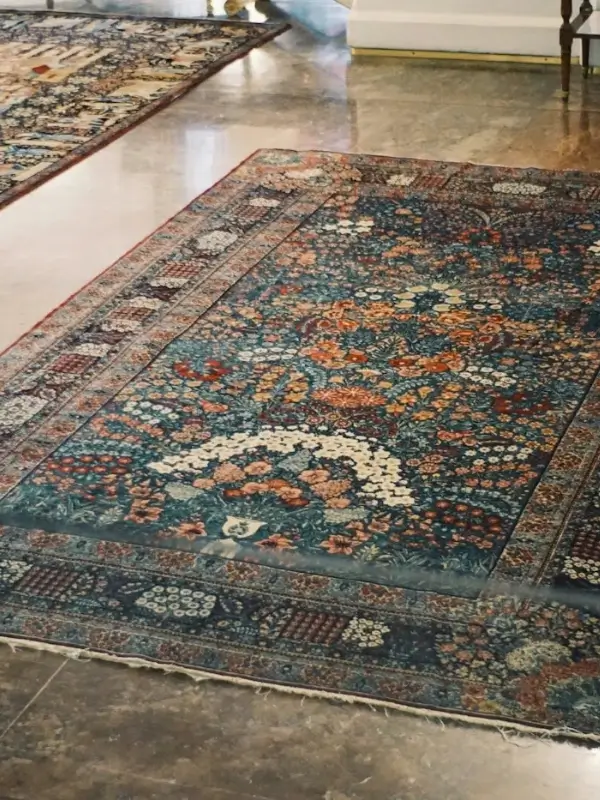
A Persian rug is one of the most repairable textiles made. Every tuft is a knot tied around a warp, so a skilled restorer can rebuild the foundation and retie the knots the way the weaver did. The challenge is matching four things at once so the repair disappears instead of standing out: the knot, the cotton or silk foundation, the wool, and natural dyes with their abrash (the gentle shifts in shade). We repair Persian rugs by hand at our Canoga Park facility, and these are the repairs we see most.
Fringe and ends
The fringe is the ends of the rug’s cotton warps, and vacuums and everyday wear snap it. Once it’s gone, the woven band at the end starts to unravel and the last rows of pile begin to drop.
Side edges
The wool wrapping along the long edges wears through from vacuums, furniture legs and foot traffic, which leaves the warps underneath exposed. Once those warps break, knots start falling out from the edge inward. An edge caught early is one of the smallest repairs, and it prevents one of the biggest.
Holes, burns and moth damage
Moth larvae feed on the wool out of sight, often under furniture. A burn or a tear can go through the foundation as well as the pile.
Worn areas
Some low pile is simply patina and doesn’t need restoring. Where wear has reached the knots and bare cotton shows, though, the exposed threads break and the worn patch spreads. The fine kork wool in Isfahan, Nain and Kashan rugs wears faster than the coarse wool of a Heriz, so their traffic areas are worth checking more often.
Most Persians we see need both a wash and a small repair, and doing both in one visit saves you a trip. Every repair is quoted individually, and the estimate is free.
Free pickup on repairs applies to jobs of $100 or more within 20 miles.
Other Rugs We Service
In addition to Persian rug cleaning, California Rug Cleaning handles every type of area rug, including machine-made, flatweave, shag, hide and runners. The four below are the ones that need a specialist’s judgment rather than a standard wash.

Oriental
Turkish, Chinese, Indian, Caucasian: construction and dye chemistry vary enormously, and so does what a rug can safely take.

Wool
Where most rug damage actually happens. Hot water and harsh detergent strip the lanolin and shrink the foundation.

Silk
The least forgiving fiber for a rug. These rugs are given the most gentle treatment, washed and finished entirely by hand.

Antique
An antique rug’s condition guides every decision. We identify dry rot, weakened areas, and old repairs before selecting a cleaning method.